
Rotary Actuator: All Facts about Rotary Drives
Rotary Actuator: Explained Briefly
If you look at Google search, the rotary actuator goes by many names: it is also referred to as a rotary drive or rotary actuator, as well as rotary cylinder, rotary motor, swivel cylinder, or swivel drive. What unites all these synonyms is their ability to deliver maximum torque in tight spaces.
The rotary actuator is based on a drive concept that allows you to rotate and pivot even the heaviest objects. Typically, these actuators operate within a range of 45° to 360°, and in extreme cases, they can even rotate up to 1440°. Eckart Hydraulics' rotary actuators are considered the absolute benchmark, often referenced in various educational and technical publications.
Now, let's dive into the details: What is a rotary actuator?
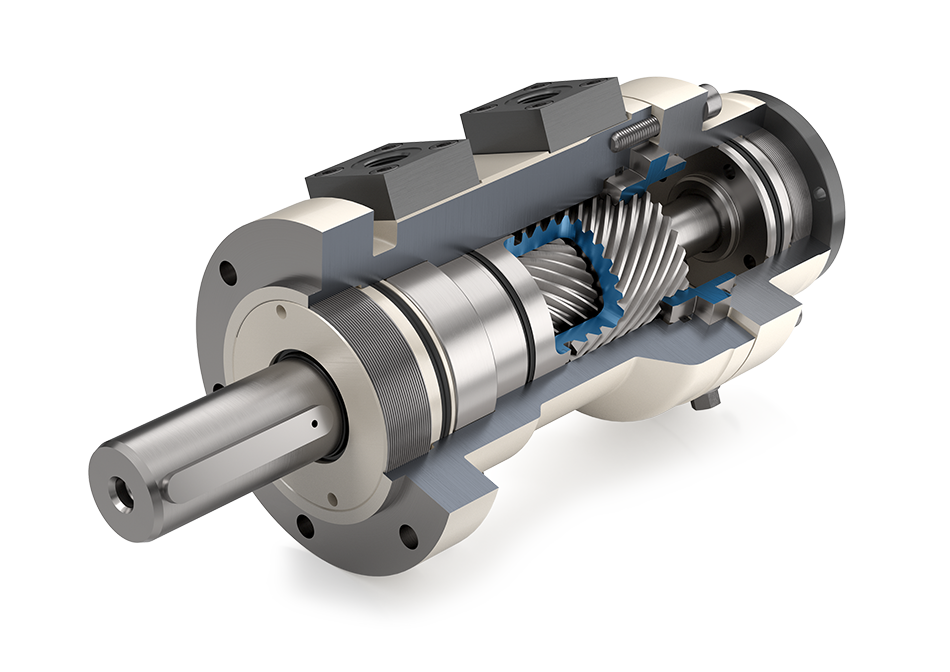
The term "rotary actuator" is defined by ISO 5598, so there is actually no other designation for this type of actuators. However, various names can be found, especially in online searches. Rotary actuators, or rotary drives, are composed of compact units that use hydraulic or pneumatic pressure to move a driveshaft in both directions. This driveshaft can rotate a digging bucket, pivot a train door, move the basket on a fire department ladder, or close heavy safety doors…to name just a few applications.
What makes them outstanding is their ability to generate maximum power in a compact design. They are secure, powerful, fast, and precise; yet easy to control. Eckart Hydraulics employs the steep gear principle for absolute power density in their rotary actuators. Our rotary actuators operate within a pressure range of 290 to approximately 3,625 psi.
What is the helix thread principle
What is the helical gear principle
It's worth noting that in some Google searches, terms like "steep thread," "steep angle," or "steep gear" may appear. The correct term, however, is "helical gear"
At Eckart hydraulic rotary drives, the helical angle of the gear profile plays a significant role. The helical angle of the gear profile in hydraulic rotary drives enables precise control and stabilization of intermediate angular positions. This is achieved by converting the linear piston motion into an effective rotational motion of the output shaft using a helical thread. This transformation is accomplished by utilizing hydraulic pressure within a small space, resulting in impressive torque generation.
The outstanding feature of the helical gear principle lies in its ability to generate high torque and exceptional holding power. It is also highly adaptable in terms of external dimensions. While this principle may seem simple at first glance, the production of functional and reliable drives requires a high degree of precision and extensive expertise in the field.

Why are Eckart Hydraulics' rotary actuators among the best in the industry?
In the realm of rotary actuators, as well as in hub-rotary units and multi-axis devices, Eckart Hydraulics is considered a significant pioneer. We take an uncompromising approach, thanks to the incorporation of the latest material research and the individual construction of rotary drives.
More than 50 years of development are invested in Eckart's drives. Over half a million rotary actuators shipped worldwide speak for themselves. They are also used in critical and highly sensitive areas, such as personal safety and rescue operations, as well as in other safety systems, the food industry, aircraft landing gear testing, ship hatches, or offshore drilling rigs. Top-quality materials, the highest manufacturing precision, lifelong support, and repair options are part of our standard. In short, Eckart Hydraulics is a name you can rely on.
These are the application areas
of rotary actuators
Rotary actuators find applications in various sectors and industries. Our motors are used in construction machinery, vehicle manufacturing, power plants, the food and pharmaceutical industries, underground, on land, and on water.
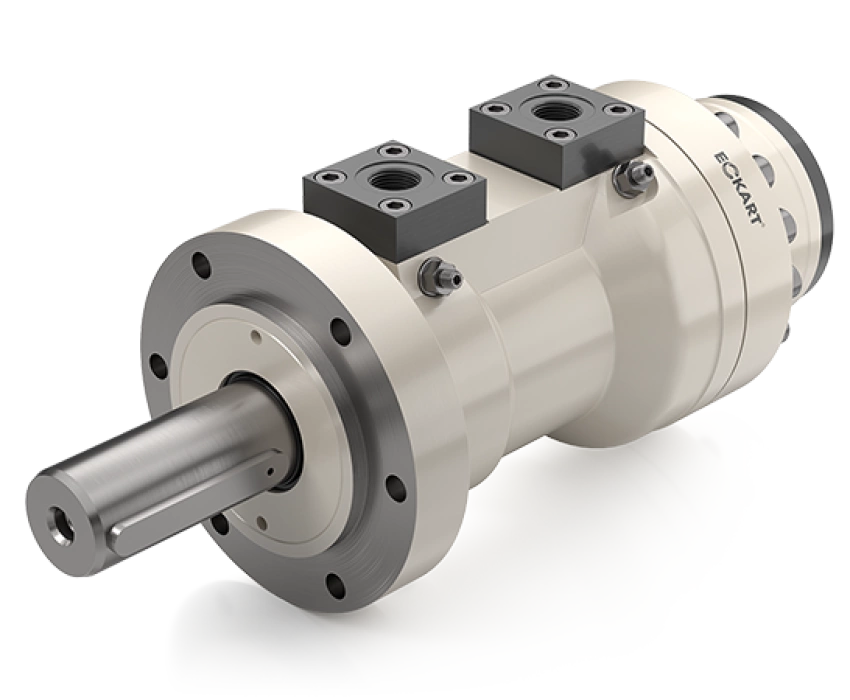
Practical Example
A rotary actuator can:
• Change, rotate, or hold tools or workpieces.
• Pivot or level work platforms.
• Operate valves.
• Pivot driver cabins.
• Flip pallets.
• Lift or sort products.
• Raise or move containers or entire walls.
• Open and close heavy safety doors.
• Unfold ship bows.
• Precisely position drilling carriages.
Linear-rotary actuator : a combined rotary actuator
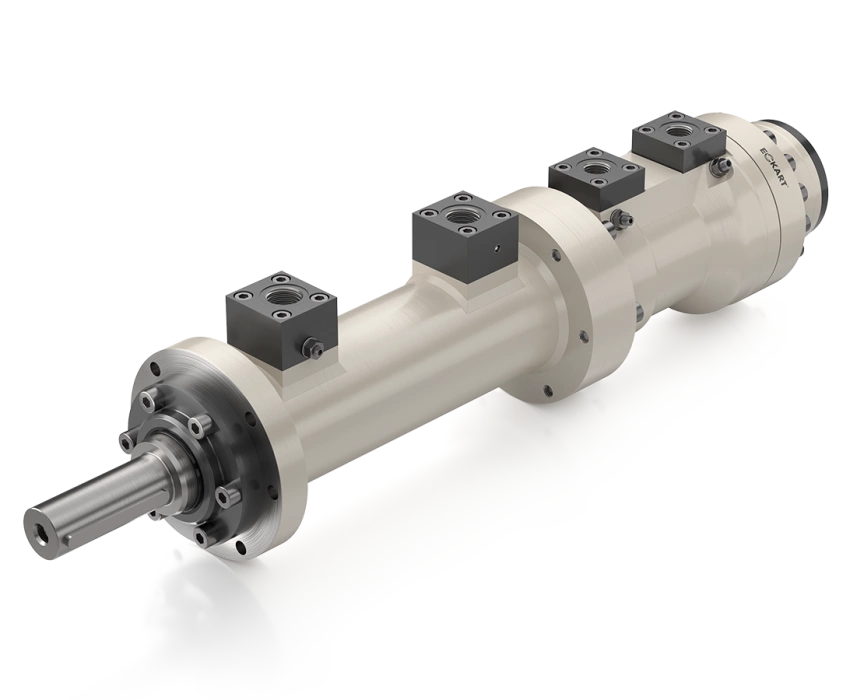
A special form of rotary actuator is the linear-rotary actuator. In this case, the classic rotary motor is combined with a double-acting linear cylinder. This allows both rotary and linear movements in a confined space. Eckart Hydraulics offers the HSE4 linear-rotary combination, providing full flexibility in tight spaces.
Both units can be controlled hydraulically separately. This enables all possible movement sequences: pivoting left and right, linear extension and retraction. Because the rotary actuator and the linear cylinder can be controlled simultaneously, movements can also be executed synchronously or in any combination as required for the application.
Practical Example
The Linear-rotary actuator can:
• Perform complete tool changes with all required movements.
• Carry out feeding movements in an assembly line.
• Lift and pivot pallets.
• Activate clamping jaws.
• Be used underwater as well.
Custom made products from Eckart Hydraulics
It goes without saying that for these complex and diverse applications, customizations are often necessary. At Eckart Hydraulics, this is part of our fundamental concept. We fulfill customer wishes 100%. You can have a rotary actuator custom-made by us, precisely according to your requirements with our expertise, and as little as one piece.
Each specially tailored drive is based on our proven three model series: SM4, E1, or E3.
Eckart Hydraulic's Rotary Actuators


Select your regional contact person
When the map (Google Maps) is called up, user-specific data is collected and cookies for external media are activated. Details in our privacy policy.
.